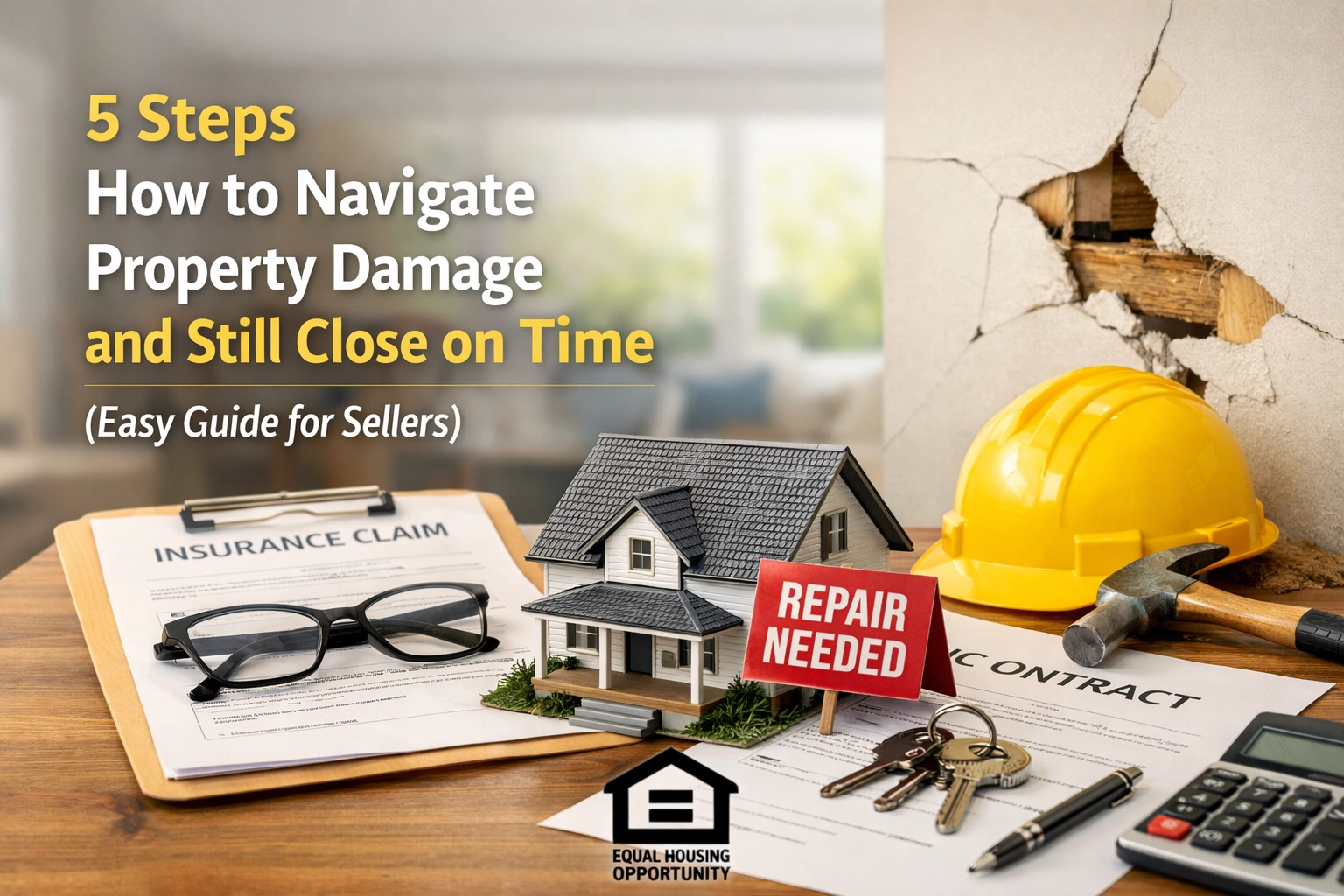
You have the "For Sale" sign in the yard, a solid offer on the table, and the boxes are half-packed. Everything is moving toward a smooth closing in Hamilton, Trenton, or across the bridge in Philadelphia. Then, the unthinkable happens. A pipe bursts in the basement, a freak storm rips shingles off the roof, or a pre-closing inspection uncovers a structural issue that wasn’t on your radar.
Panic sets in. You start wondering if the deal is dead or if you’ll be stuck paying for two mortgages while you fight with a contractor.
In my years serving these communities as both a Real Estate Agent and a Public Insurance Adjuster, I have seen this scenario play out more times than I can count. My dual background in construction and insurance claims gives me a unique lens through which to view these "deal-killers." To me, property damage isn’t a reason to walk away; it’s a problem with a professional solution.
Here is my 5-step guide to navigating property damage and keeping your closing date on track.
1. Stop, Document, and Assess (The Adjuster’s Eye)
The moment damage is discovered, your first instinct might be to call a repairman. While stopping further damage is critical (like turning off the main water valve), your second step must be documentation.
Because I work as a Public Insurance Adjuster, I approach this differently than a standard real estate agent. I look for the "scope of loss." Before you clean up the mess, take high-resolution photos and videos of everything. In older homes in Trenton or rowhouses in Philly, water damage can migrate quickly through common walls or basement foundations.
What to document:
- The source of the damage (e.g., the cracked pipe).
- The immediate aftermath (standing water, fallen drywall).
- Any personal property affected.
Having this documentation is vital if we decide to file an insurance claim. It provides the "proof of loss" needed to ensure the insurance company doesn’t lowball your payout: a common issue that can stall a real estate transaction.

2. Immediate Disclosure and Transparency
In New Jersey and Pennsylvania, disclosure laws are strict. If damage occurs while the home is under contract, you have a legal and ethical obligation to inform the buyer.
Many sellers fear that telling the buyer will cause them to flee. However, hiding damage is a surefire way to land in a lawsuit post-closing. My approach is to notify the buyer’s side immediately: but with a solution already in hand. Instead of saying, "The roof is leaking," we say, "A leak was detected, our expert has already assessed the scope, and we are currently determining the most efficient path to repair it before the walkthrough."
This transparency builds trust. It shows the buyer that they are dealing with a professional who takes care of the property, which is often enough to keep them from getting cold feet.
3. The Big Decision: Insurance Claim vs. Repair Credit
This is where my dual expertise really saves my clients time and money. When damage occurs mid-sale, we have two primary paths to keep the deal moving: filing an insurance claim or offering a repair credit.
Filing an Insurance Claim
- Pros: This preserves your net proceeds. If a storm causes $20,000 in roof damage, the insurance company pays for it (minus your deductible), meaning that money doesn't come out of your pocket at the closing table.
- Cons: It can take time. Adjusters need to visit, estimates need to be approved, and contractors need to be scheduled.
Offering a Repair Credit
- Pros: Speed. We get a licensed contractor to give us a solid estimate, and we simply deduct that amount from the sale price or provide a credit toward the buyer's closing costs. This usually allows us to close on the original date.
- Cons: This comes directly out of your profit.
How I help you choose:
I analyze the math. If the damage is $3,000 and your deductible is $1,000, filing a claim might not be worth the potential delay. However, if it’s a major loss, I can leverage my Public Adjuster skills to expedite the claim process, often negotiating with the carrier to ensure the work is done to the highest standards or that the funds are available for the buyer to handle repairs post-closing through an escrow holdback.
4. Leverage Construction Knowledge for Rapid Repairs
If we choose to repair the damage before closing, we can't afford to hire "handyman Joe" from a Facebook ad. You need licensed, insured contractors who understand the urgency of a real estate closing.
Because of my construction background, I maintain a curated list of reliable contractors in the Hamilton and Philadelphia areas. I know what a quality repair looks like, and I know how to read an estimate to ensure you aren't being overcharged because of your "emergency" status.
When repairs are completed, we don't just take the contractor's word for it. We need:
- Paid-in-full receipts.
- Transferable warranties (a huge selling point for the buyer).
- Photos of the completed work.
Providing a "Repair Package" to the buyer's agent before the final walkthrough removes the "fear of the unknown" and keeps the process moving toward the finish line.

5. Mastering the Final Walkthrough Negotiation
The final walkthrough is usually the most stressful part of a sale, even without property damage. When there has been a recent repair, the buyer will be looking at the house with a magnifying glass.
To ensure we close on time, I prepare a "Transition of Care" folder. This includes all the documentation from step one, the insurance claim details (if applicable), the contractor's invoices, and warranties.
If the buyer is still hesitant, this is where my negotiation skills as a real estate professional come into play. We might suggest a small "peace of mind" credit or an escrow holdback: where a portion of the sale proceeds is held by the title company until the buyer is satisfied with the repair after living in the house for a week.
My goal is always to find the win-win. We want you to move on to your next chapter, and we want the buyer to feel confident in their new home.
Why Experience Matters in These Moments
Selling a home is one of the most significant financial transactions of your life. When property damage enters the mix, the stakes get even higher. You shouldn't have to juggle a real estate agent, an insurance adjuster, and a contractor separately while trying to pack your life into boxes.
I built Go Ramsie Homes Powered by eXp to be a one-stop resource. I recognized early in my career that my passion for construction and my commitment to advocating for homeowners through insurance claims were the perfect complements to real estate. I don't just list homes; I protect your investment through every stage of the sale.
Whether you are dealing with a historic home in Trenton that needs a delicate touch or a modern townhouse in Philadelphia, I strive to provide the highest quality of service. My philosophy is simple: I treat your home as if it were my own, diligently working to ensure that no obstacle: not even a burst pipe: stands in the way of your goals.
Together, we can navigate the complexities of the market and the surprises of homeownership. If you are worried about the condition of your home or have recently discovered damage, let’s talk before you make a move. Excellence in real estate isn’t just about the sale; it’s about the solutions we provide along the way.
Ready to sell with confidence?
Visit my website to get started or explore our site map for more resources on the Hamilton and Philadelphia markets.
Go Ramsie Homes Powered by eXp is committed to the letter and spirit of U.S. policy for the achievement of equal housing opportunity throughout the Nation. We encourage and support an affirmative advertising and marketing program in which there are no barriers to obtaining housing because of race, color, religion, sex, handicap, familial status, or national origin.
🏠 Equal Housing Opportunity
Leave a Reply